Still in Post-Normal Times (not the New Normal) in the Legal Industry
I see many references to the legal industry finding itself in a “new normal,” most prominently as the title of Patrick Lamb’s and Paul Lippe’s thoughtful ABA Journal column, but also in plenty of other places. I have used the term frequently myself. But what’s “normal” about the “new normal” in law? After all, normal means “conforming to a standard; usual, typical, or expected.” My sense is that there is a lot going on in legal practice these days that is unusual, atypical, and unexpected. So, not normal.
An alrternative description—one I will use henceforth—is that the legal industry is in Post-Normal Times. The concept of Post-Normal Times was developed in 2010 by scientist Ziauddin Sardar to describe the turbulent and changing times we are living in. He based his idea on the work of Silvio Funtowicz and Jerome Ravetz, who in the early 1990s challenged conventional science with their model of Post-Normal Science as a methodology of inquiry that is appropriate for cases where “facts are uncertain, values in dispute, stakes high and decisions urgent.” This graph illustrates their focus on two variables—decision stakes and systems uncertainties—defining the environment for using Post-Normal Science as a methodology:
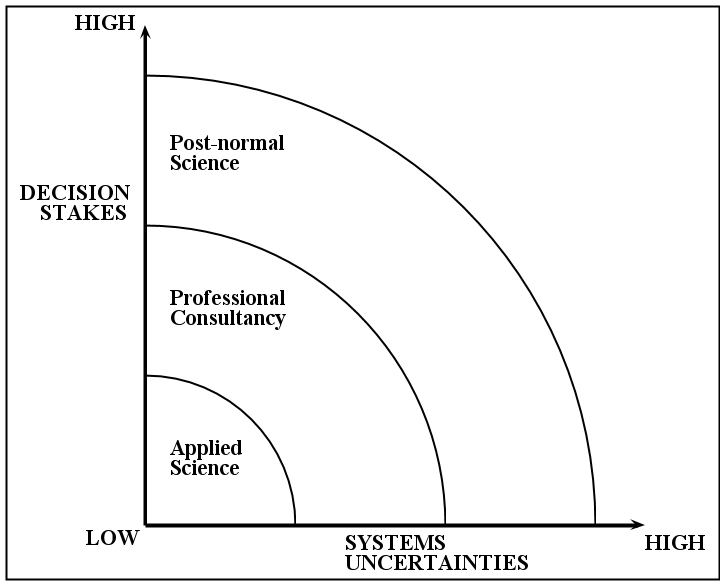
Applied science and other traditional problem-solving strategies do not work well in the context of long-term issues where there is less available information than is desired by stakeholders. Post-Normal Science advocates creating an “extended peer community” consisting of all those affected by an issue who are prepared to enter into dialogue on it.
Building on that theme, Sardar defines Post-Normal Times as “an in-between period where old orthodoxies are dying, new ones have yet to be born, and very few things seem to make sense.” He elaborates on the nature of Post-Normal Times:
All that was ‘normal’ has now evaporated…. To have any notion of a viable future, we must grasp the significance of this period of transition which is characterised by three c’s: complexity, chaos and contradictions. These forces propel and sustain postnormal times leading to uncertainty and different types of ignorance that make decision-making problematic and increase risks to individuals, society and the planet. Postnormal times demands, this paper argues, that we abandon the ideas of ‘control and management’, and rethink the cherished notions of progress, modernisation and efficiency. The way forward must be based on virtues of humility, modesty and accountability, the indispensible requirement of living with uncertainty, complexity and ignorance. We will have to imagine ourselves out of postnormal times and into a new age of normalcy—with an ethical compass and a broad spectrum of imaginations from the rich diversity of human cultures.
Ziauddin Sardar, “Welcome to postnormal times,” Futures 42(2010) 435-444.
That sounds a lot more like the legal industry’s current predicament than “new normal” conveys. If so, are humility, modesty, and accountability at least part of the answer for law’s imagining itself out of postnormal times and into a new age of normalcy?
Forms of Bespoke Lawyering and the Frontiers of Artificial Intelligence
In Machine Learning and Law, Harry Surden of the University of Colorado Law School provides a comprehensive and insightful account of the impact advances in artificial intelligence (AI) have had and likely will have on the practice of law. By AI, of course, Surden means the “soft” kind represented mostly through advancement in machine learning. The point is not that computers are employing human cognitive abilities, but rather that if they can employ algorithms and other computational power to reach answers and decisions like those humans make, and with equal or greater accuracy and speed, it doesn’t matter so much how they get there. Surden’s paper is highly recommended for its clear and cogent explanation of the forms and techniques of machine learning and how they could be applied in legal practice.
Surden quite reasonably recognizes that AI, at least as it stands today and in its likely trajectory for the foreseeable future, can only go so far in displacing the lawyer. As he puts it, “attorneys, for example, routinely combine abstract reasoning and problem solving skills in environments of legal and factual uncertainty.” The thrust of Surden’s paper, therefore, is how AI can facilitate lawyers in exercising those abilities, such as by finding patterns in complex factual and legal data sets that would be difficult for a human to detect, or in enhancing predictive capacity for risk management and litigation outcome assessments.
What Surden is getting at, in short, is that there seems to be little chance in the near future that AI can replicate the “bespoke lawyer.” That term is used throughout the commentary on the “new normal” in legal practice (which is actually a “post normal” given we have not reached any sort of equilibrium). But it is not usually unpacked any further than that, as if we all know intuitively what bespoke lawyering is.
To take a different perspective on bespoke lawyering and the impact of AI, I suggest we turn Surden’s approach around by outlining what is bespoke about bespoke lawyering and then think about how AI can help. In the broadest sense, bespoke lawyering involves a skill set that draws heavily from diverse and deep experience, astute observation, sound judgment, and the ability to make decisions. Some of that can be learned in life, but some is part of a person’s more complex fabric—you either have it or you don’t. If you do have these qualities under your command, however, you have a good shot at attaining that bespoke lawyer status. Here’s a stab at breaking down what such a lawyer does well:
Outcome Prediction: Prediction of litigation, transaction, and compliance outcomes is, of course, what clients want dearly from their lawyers. On this front AI seems to have made the most progress, with outfits like Lex Machina and LexisNexis’s Verdict & Settlement Analyzer building enormous databases of litigation histories and applying advanced analytics to tease out how a postulated scenario might fare.
Analogical and evaluative legal search: Once that pile of search results comes back from Lexis or Westlaw (or Ravel Law or Case Text), the lawyer’s job is to sort through and find those that best fit the need. Much as it is used in e-discovery, AI could employed to facilitate that process through machine learning. This might not be cost-effective, as often the selection of cases and other materials must be completed quickly and from relatively small sets of results. Also, the strength of fit is often a qualitative judgment, and identifying useful analogies, say between a securities case and an environmental law case, is a nuanced cognitive ability. Nevertheless, if a lawyer were to “train” algorithms over time as he or she engages in years of research in a field, and if all the lawyers in the practice group did the same, AI could very well become a personalized advanced research tool making the research process substantially more efficient and effective.
Risk management: Whereas outcome prediction is usually a one-off call, managing litigation, transaction, and compliance outcomes over time requires a sense of how to identify manage risk. Kiiac’s foray into document benchmarking is an example of how AI might enhance risk management, allowing evaluation of massive transactional regime histories for, say, commercial real estate developers, to detect loss or litigation risk patterns under different contractual terms.
Strategic planning: Lawyers engage extensively in strategic planning for clients. Where to file suit? How hard to negotiate a contract term? Should we to disclose compliance information? Naturally, it would be nice to know how different alternatives have fared in similar situations. Here again, AI could be employed to detect those patterns from massive databases of transactions, litigation, and compliance scenarios.
Judgment (and judging): Judgment about what a client should do, or about how to decide a case when judge, involve senses not easily captured by AI, such as fairness, honesty, equity, and justice. The unique facts of a case may call for departure from the pattern of outcomes based on one of these sensibilities. Yet doctrines do exist to capture some of these qualities, such as equitable estoppel, apportionment of liability, and even departure from sentencing guidelines, and these doctrines exhibit patterns in outcomes that may be useful for lawyers and judges to grasp in granular detail. What is equitable or just, in other words, is not an entirely ad hoc decision. AI could be used to decipher such patterns and suggest how off the mark a judgment under consideration would be.
Legal reform: As I tell my 1L Property students, in almost every case we cover some lawyer was arguing for legal reform—a change in doctrine, a change in statutory interpretation, striking down an agency rule, and so on. And of course legislatures and agencies, when they are functional, are often in the business of changing the law. To some extent arguments for reform go against the grain of existing patterns, although in some cases they pick up on an emerging trend. They also rely heavily on policy bases for law, such as equity, efficiency, and legitimacy. In all cases, though the argument has to be that there is something “broken” about continuing to apply the existing law, or to not invent new law, in the particular case or broader issue in play. AI might be particularly useful as a way of building that argument, such as by demonstrating a pattern of inefficient results from existing doctrine, or detecting strong social objection to an existing law.
Trendspotting: In my view the very best lawyers—the most bespoke—are those ahead of the game—the trendspotters. What is the next wave of litigation? Where is the agency headed with regulation? Which law or doctrine is beginning to get out of synch with social reality? Spotting these trends requires the lawyer to get his or her head outside the law. Here, I think, AI might be most effective in assisting the bespoke lawyer. A plaintiffs firm, for example, might use AI to monitor social media to identify trends highly associated with the advent of new litigation claims, such as people complaining on Twitter about a product. Similarly, this approach could be used to inform any of the lawyer functions outlined above.
Handling people: Ultimately, a top lawyer builds personal relationships with colleagues, peers, and clients. AI can’t help you do that, I don’t think, but by helping lawyers do all of the above it may free up time for a game of golf (tennis for me) with a client!
Law 2050 Students Take a Deep Dive into Neota Logic
Many, many years ago, when I was practicing environmental law with Fulbright & Jaworski in Austin, I was unfortunate enough to have a number of clients whose needs required that I master the EPA’s utterly convoluted definition of solid and hazardous waste. One summer I assigned a summer associate the task of flowcharting the definition. Over the course of the summer we debugged draft after draft until, finally, we had a handwritten flowchart that flawlessly worked any scenario through the definition step-by-step. It was ten legal-sized, taped-together pages long. It worked, but it wasn’t very practical.
If only we had had Neota Logic back then! Last week, in my Law 2050 class, Kevin Mulcahy, Director of Education for Neota, demoed their product over the course of two classes and a 3-hour evening workshop. Prior to the session I had assigned the class the exercise of flowcharting the copyright law of academic fair use. Each student prepared a flowchart and explained its logic, then six groups collaborated on final work products. I sent the group flowcharts to Kevin so he could use them to explain the Neota platform in a context familiar to the students.
Neota is a software program that allows the user to translate legal (or other) content into a user-friendly interactive application environment, much like Turbo Tax does for tax preparation. Neota allows the content expert to build the app with no coding expertise, with end products that are quite sophisticated in terms of what can be embedded in the app and how smoothly the app walks the user through the compliance logic. Example apps Kevin offered covered topics as varied as songwriter rights to Dodd-Frank compliance.
The first class period Kevin introduced Neota and then walked through each of the group flowcharts to analyze how each one broke down the fair use compliance problem. The core theme was how important it is to develop the output scenarios first. In the fair use exercise, there are several yes/no questions specific to educational uses, and then a multi-factored balancing test applies in the event none of those binary questions leads to a fair use outcome. Like any balancing test, this one yields a range of scenarios from very likely fair use to very likely not fair use. We spent a good deal of time thinking about how to design an app component to capture the balancing test.
In the evening workshop a group of 20 students acted as content experts to guide Kevin through the process of building the fair use app, much in the way a legal expert might work worth a Neota software expert. The most striking learning experience from this session, besides the deep look under Neota’s hood, was how the process of building the app actually sharpened our fair use compliance logic. We tested various approaches for capturing the balancing test and conveying output scenarios with substantive explanations for the user.
The next day the entire class regrouped to go over the workshop product, allowing those who could not make the workshop due to conflicting classes the chance to get a good feel for both the flexibility and precision the Neota software offers. Thinking back to my perfectly accurate but impractical ten-page flowchart of the EPA’s waste definition, I could envision how that and many other tasks that required developing a compliance logic could have been leveraged into apps I could have shared with other attorneys in my firm as well as clients.
My Law 2050 students clearly got a lot out of the immersion in using Neota to attack a compliance logic problem. I can’t thank Kevin and Neota enough for the time he invested in preparing for and delivering what was an excellent hands-on and instructive workshop. By the way, the EPA now has an online decision tool for navigating through the waste definition. I think they might want to get in touch with Neota!
 Law 2050