Home » Legal Practice (Page 3)
Category Archives: Legal Practice
Inventing the Next Shipwreck (and Shipwreck Law)
There is a saying that whoever invented the ship also invented the shipwreck. The point is that new technologies can have their pros and cons, and some of both can be entirely unexpected. Technological innovations thus have always been a challenge for law—how can we facilitate the good while regulating away the bad, especially when we don’t have a full grasp on all of the goods and bads? But that also means technological innovation leads to legal innovation, and opportunity for lawyers to open up new fields of expertise. So, whoever invented the ship also opened the door for lawyers to invent shipwreck law!
The second major category of my student bar journal articles in the Law 2050 class was all about inventing the next shipwrecks with new technology and how law might respond. Like the topic of the first category of articles I covered—the sharing economy—student papers covered varied topics in thoughtful and insightful ways.
I could have used “dronewrecks” for my title, because a healthy number of papers looked at how we are going to take advantage of drones in various commercial applications without running into obvious problems like them crashing into homes and each other (and people). There is interest in applying drones for newsgathering, television and film production, law surveillance, and commercial delivery. A brewery in Minnesota used drones to deliver cases of beer to people ice fishing, until the FAA shut that down. Ah yes, the FAA—the agency is working on regulations for drones, which they refer to as “unmanned aircraft systems,” which the industry fears will be quite constraining of the new technology. States are entering the field as well. My students predicted a slow, incremental approach to easing in of drones under aviation regulation.
The same is true for the close cousins of drones—driverless cars and crewless cargo ships. Driverless cars, which some students covered last year, seem to be moving slowly toward market with regulation moving cautiously to let that happen. But crewless cargo ships? Well, why not? The EU and Rolls Royce are developing the technology, which raises all sorts of pros (lower labor costs, less environmental waste, no crew safety concerns) as well as interesting questions (job losses, cyber-piracy, runaway ships). Both the International Marine Organization and the insurance industry will have plenty of interest in how this develops.
Other topics covered in student papers, from tame to most out there, included:
- Bitcoins and other digital payments
- Regulation of 3D handguns
- Smartphone apps that allow the user to upload series of pictures to 3D printers, thus eliminating the need for CAD programs and allowing easy copying of sculptures and other forms
- 3D bioprinting of organs
- Organs on chips
- Commercial spaceflight
- Asteroid mining and other space property claims
- Neural implants
- My personal favorite—personal invisibility devices (don’t think they’re not working on them!)
The point of the assignment, of course, is to push students to think about law’s development in an entrepreneurial way. Although many of these technologies have a home in an established field (e.g., drones in aviation law; 3D printing in IP law), the established field isn’t a perfect fit and no lawyer is more of an expert on what doesn’t fit than anyone else. There’s no reason a recent law school graduate can’t bust into an established field on the crest of a new technology, outlining the challenges and proposing thoughtful legal innovation, to make his or her brand valued. Kudos to my students for taking that objective to heart and producing many excellent papers I’m sure bar journals would be happy to publish!
Impact Scores for Disruptive Legal Technologies
This will date me, but I remember a day when law was practiced without computer-based Westlaw or Lexis, when legal technology consisted of the five essentials: a land line telephone, Dictaphone, IBM Selectric, light switch, and thermostat. Westlaw and Lexis were, from the late 1970s until 1986, accessed only via phone modem. I recall using the modem in law school, and then at my firm in the mid-1980s experienced the miracle of using a computer to run simple searches. Life after that was not the same.
So this is not the first time legal practice has faced “disruptive technology.” But what exactly does that mean—disruptive technology? And how do we apply a metric to “disruptiveness”?
As many readers will know, the origins of the term stem from Harvard Business School Professor Clayton Christensen’s theory of disruptive and sustaining innovations. A disruptive innovation helps create a new market or industry and eventually disrupts an existing market or industry. In contrast, a sustaining innovation does not create new markets or industries but rather evolves existing ones to achieve better value.
Much of the commentary on new legal technologies has focused on the disruptive side of the equation, whereas many have a sustaining quality as well. Overall, however, I don’t find that dichotomy very useful for purposes of understanding and teaching how the new wave of legal technology will affect the practice of law and thereby affect the demand for lawyers. So this fall in my Law 2050 class my students and I disaggregated “disruptive” and “sustaining” to get more under the hood of how new technology platforms like Lex Machina, Legal Zoom, Ravel Law, and Neota Logic will change the way law is practiced. (We did so purely intuitively without dipping deeply into Christensen’s detailed theory or other business theory and commentary on the topic—so he and my colleagues at Vanderbilt’s Owen Graduate School of Business Management might cringe at what follows.) Modifying somewhat the typology we developed in class, below I use the introduction of Westlaw and the current play of Lex Machina to explain our typology and impact scoring system.
What is disruptive (and sustaining) about disruptive legal technology?
One way of thinking about how new technologies change the world is to ask a “technology native”—a person who has only known life with the technology—what his or her world would be like if the technology disappeared. For example, while I actually was able to get by years ago without Google (I am a Google “technology immigrant”), I can’t imagine my world without Google now, but I can remember one. So just think about a Google native—someone who has never seen life without Google! Ironically, with Westlaw and Lexis this is becoming increasingly less scary, as Google alone has supplanted them as the first search engine of choice for many legal searches. But let’s envision Westlaw and Lexis coming on line in the 1980s or disappearing in the 2010s and ask, so what, who cares, and why? In what ways is the world of lawyering different with or without them? I come up with five effects, each of which has a 20-point impact scale:
Quality enhancing impact: In the do it better, faster, and cheaper trilogy dominating the legal industry today, quality enhancing technology works on the delivery of better service. For example, Westlaw and Lexis vastly improved the accuracy of search results, such as “find cases from the federal courts in the Fifth Circuit that say X and Y but not Z.” Sure, a lawyer could have run key number headings in the books and read through legal encyclopedias, but the miss rate simply went down when Westlaw and Lexis came on line. So to, with its deep database of IP cases and filings and assessable research design, does Lex Machina improve accuracy of searches about IP litigation, though at present it does not run broad substantive research searches. Scores: Westlaw and Lexis 18 (like Russian skating judge, leaving room for some later contenders); Lex Machina 12
Efficiency enhancing impact: Anyone who has ever run key numbers in hard copy digests or Shepardized a case using the books will appreciate the efficiency enhancement Westlaw and Lexis provided—the “do it faster” component of today’s client demands. Similarly, although one could use the brute force of Westlaw or Lexis searches to assemble the results of a Lex Machina search about the IP litigation profile of a judge or patent, it’s a heck of a lot faster using Lex Machina. Scores: Westlaw and Lexis 18; Lex Machina 18.
Demand displacement effect: Assume a world in which the number and scope of client driven legal searches does not change. In that case, the introduction of a new legal technology that has quality and efficiency enhancement effects is likely to displace demand for service in some sectors of the legal industry if the technology is a cost-effective competitor. For example, Westlaw and Lexis allowed better and faster legal searches, but unless priced to be cost-competitive with the old lawyer-intensive ways of doing legal searches, they won’t penetrate the market. Bottom line, there are fewer billable hours to go around. Given the success of Westlaw and Lexis in establishing their markets, one has to assign them the potential for this displacement effect. It’s much harder to tell with Lex Machina, because it’s not clear what the demand was for the information its type of searches provides prior to its availability. Scores: Westlaw and Lexis: 15; Lex Machina 8
Transformative effect: The opposite side of the coin is the potential a new technology has to open up new markets for legal tasks not previously possible or valued. For example, other than paying for a bespoke lawyer’s judgment about the profile of a particular court for IP litigation, I find it hard to believe many clients would have paid lawyers to perform the kinds of hyper-detailed big data litigation information searches Lex Machina makes possible about lawyers, courts, and patents. Even more so, some of the search techniques Westlaw and Lexis made possible would have been virtually impossible to replicate the old fashioned way with the books. To the extent these new capacities are valued—e.g., they lead to better litigation prediction and outcomes—they will increase demand for service. Hence the transformative effect can work to offset the displacement effect, meaning a new legal technology might increase the pool of billable hours. Scores: Westlaw and Lexis 15, Lex Machina 12
Destructive effect: All of the above discussion has assumed it will be lawyers using the new technology, which clearly will not always be the case—the new technology might reduce or eliminate the need for a lawyer at the helm. Some new technologies will provide user interfaces that do not require an attorney to operate. The rise of paralegals conducting research on Westlaw and Lexis is an example. Even more destructive are technologies like predictive coding, used in e-discovery to vastly reduce the need for lawyers, and online interfaces such as Legal Zoom, which sidesteps the Main Street lawyer altogether. My sense is that Westlaw and Lexis did not have so much destructive effect outside of pushing some work down to paralegals, and the same will hold true for Lex Machina. Scores: Westlaw and Lexis: 8; Lex Machina 8.
Total Impact Scores: Westlaw and Lexis 74; Lex Machina 58.
Of course, this is all meant to be a bit provocative and poke some at the overuse and misuse of the “disruptive technology” theme in our current legal world. As I said, it is not informed by formal business theory, nor do I have any empirical evidence to back up my scores. But the categories of effects seem on point and relevant to the discourse on impacts of new legal technologies, and the scores strike me as decent ballpark estimates. At the very least, I’ll have a model the students can use to dissect the legal technologies they choose to study in next fall’s Law 2050 class!
Regulatory Innovation and the Sharing Economy
My Law 2050 energy has been devoted the past month to grading a pile of fabulous papers my students compiled on a broad variety of topics and planning some exciting new developments here at Vanderbilt. More on the latter, later. For now, some observations on several trends in law based on the student papers.
The major writing assignment in the law 2050 class requires students to identify an “inside law” or “outside law” trend and cover it in a blog post, client alert latter, and bar journal article. The purpose is twofold: (1) expose them to writing styles their future employers are likely to expect them to use for professional development and (2) encourage entrepreneurial thinking about how to “jump on” emerging themes and opportunities.
As I have mentioned before, the breadth of “outside law” topics was impressive. Three major themes dominated, however: (1) regulating the so-called sharing economy; (2) weird new technologies; and (3) personal data privacy. Taking them one at a time, this post covers the sharing economy, a snarl of legal issues that ought to keep plenty of lawyers busy for the foreseeable future.
The engine of the sharing economy, no surprise, is the internet and its capacity to link people. Sharing economy companies leverage this capacity to match supply and demand primarily for services, the big three so far being rides (e.g., Uber), rooms (e.g., Airbnb), and odd jobs and errands (e.g., TaskRabbit).
Two opposing narratives have dominated the debate over how to receive the sharing economy. In one, sharing economy companies project themselves as innovative middlemen who merely use smart phone technology to hook up willing service providers with those in need of a ride, place to stay, or broken pipe fixed. In the other narrative, regulated companies in the traditional economy who see the sharing economy as completion accuse its participants of illegally and unfairly skirting rules and regulations running the gamut from licensing to taxes to employment. Which is it? It seems like a little of both to me, which is what has made the sharing economy a regulatory challenge.
The rhetoric of the sharing economy began with its name, because it is not at all about sharing—it’s about charging for services. When ride-share companies ramped up around the nation, for example, they took the position that it was simply about using phones and their smart software to match people who needed a ride with people who for whatever reason felt like driving people around—any exchange of money from passenger to driver was a “donation.” But now with surge pricing and capitalized values in the billions, the sharing economy looks much more like a business model. The other preposterous premise of the sharing economy was that it is quaint and benign, presenting no concerns that should catch the eye of regulation.
The sharing narrative fell apart pretty fast, however, and the rhetoric shifted to fending off the regulatory wolves. Questions raised about the ride-room-errand trio have been so obvious, however, it’s clear the inventors of the sharing economy decided just to go forward without asking permission and wait to see what hit the fan, when, and where. After all, it’s no accident that we regulated rides, rooms, and errands for hire, and for good reason—just check into the history of taxis in major cities in the early 1900s and you’ll find plenty of horror stories. Even a short typology of legal and regulatory issues these new upstarts present is chock full of issues:
- business licensing and taxes: Must Uber or its drivers be licensed as a taxi; must Airbnb or its “landlords” pay hotel taxes
- employment status: Are Uber’s drivers and TaskRabbit’s tasklers independent contractors or employees?; Who payes TaskRabbit’s tasker employment taxes?
- health & safety regulation: Are Airbnb accommodations subject to health regulations and the ADA
- insurance and liability: Who is liable when an Airbnb “tenant” burns down the apartment or an Uber driver assaults a passenger or drives into a building?
- zoning: What if local zoning does not allow hotels in a particular area–can Airbnb operate there?
- private contracts: What is homeowner association bylaws or an apartment lease restrict rentals and sublets?
On the other hand, it’s just as clear that the regulatory system has gone far beyond managing the problems presented by unrestricted ride, room, and errands providers to become part of the problem, protecting the taxis, hotels, and other services industries as much if not more than it protects consumers. Surely the regulated companies do deserve some protection in return for bearing the burden of regulation, such as the fixed rates taxis must charge regardless of demand. But if I can get an Uber driver at a busy downtown location in one minute, have him or her drive me safely back to my reasonably-priced Airbnb apartment I rented for the weekend late the prior week, and get someone over quickly to clean up the place before I turn in the key, what’s wrong with that? It’s hard to get that from the traditional regulated economy. And if the traditional regulated economy isn’t meeting demand, it’s worth taking a step back to ask how to improve the system.
So we have a regulatory conundrum on our hands: consumers love the sharing economy, but want some acceptable level of security and protection; entrenched regulated providers in the traditional economy such as taxis and hotels hate the sharing economy, but can’t deliver its same level of convenience because of regulation; government sees licensing fee and tax revenue slipping away, and can’t please both consumers and the regulated industries.
At the two extremes, one approach would be to unflinchingly apply all the status quo rules of the traditional regulated economy to the sharing economy, which would largely eliminate it, and the other would be to simply turn a blind eye and let tort law sort out the provider-customer relations in the sharing economy, which will cut deep into the stability of the regulated ride, room, and errands providers of the traditional economy. For a while it looked as if the live and let live model was prevailing, as companies like Uber and Airbnb shot into hipster prominence. More recently, however, the sharing economy has taken serious hits, such as Uber’s complete ban in Nevada and fines in San Francisco and Airbnb’s tangles with New York, to name just a few.
A compromise would be to think hard about innovative regulation for the sharing economy. Eric Biber and I, for example, have suggested using a general permitting approach to segregate different segments of sharing economy markets in terms of level of activity and corresponding level of regulation. Or, as Shrai Shapiro has suggested, intermediate forms of regulation, fees, and licensing could be used to open markets to the sharing economy in limited ways. Nashville, for example, recently allowed Uber to operate at the City’s airport, but subjected it to registration, insurance, inspection, and background check requirements.
Either way, its clear that the sharing economy is not going away, but neither are consumer protection regulation, licensing fees, and taxes. The legal issues remain numerous and unresolved. I was glad to see several of my students take hold of this theme and delve deeply and insightfully into its future.
Still in Post-Normal Times (not the New Normal) in the Legal Industry
I see many references to the legal industry finding itself in a “new normal,” most prominently as the title of Patrick Lamb’s and Paul Lippe’s thoughtful ABA Journal column, but also in plenty of other places. I have used the term frequently myself. But what’s “normal” about the “new normal” in law? After all, normal means “conforming to a standard; usual, typical, or expected.” My sense is that there is a lot going on in legal practice these days that is unusual, atypical, and unexpected. So, not normal.
An alrternative description—one I will use henceforth—is that the legal industry is in Post-Normal Times. The concept of Post-Normal Times was developed in 2010 by scientist Ziauddin Sardar to describe the turbulent and changing times we are living in. He based his idea on the work of Silvio Funtowicz and Jerome Ravetz, who in the early 1990s challenged conventional science with their model of Post-Normal Science as a methodology of inquiry that is appropriate for cases where “facts are uncertain, values in dispute, stakes high and decisions urgent.” This graph illustrates their focus on two variables—decision stakes and systems uncertainties—defining the environment for using Post-Normal Science as a methodology:
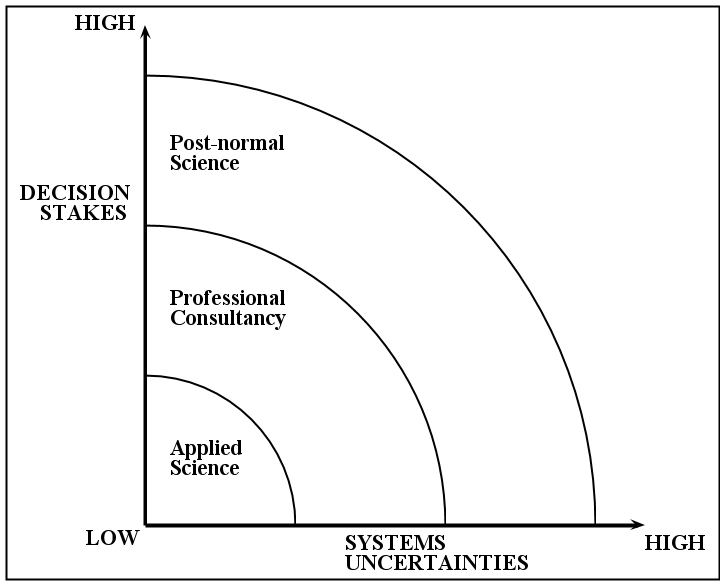
Applied science and other traditional problem-solving strategies do not work well in the context of long-term issues where there is less available information than is desired by stakeholders. Post-Normal Science advocates creating an “extended peer community” consisting of all those affected by an issue who are prepared to enter into dialogue on it.
Building on that theme, Sardar defines Post-Normal Times as “an in-between period where old orthodoxies are dying, new ones have yet to be born, and very few things seem to make sense.” He elaborates on the nature of Post-Normal Times:
All that was ‘normal’ has now evaporated…. To have any notion of a viable future, we must grasp the significance of this period of transition which is characterised by three c’s: complexity, chaos and contradictions. These forces propel and sustain postnormal times leading to uncertainty and different types of ignorance that make decision-making problematic and increase risks to individuals, society and the planet. Postnormal times demands, this paper argues, that we abandon the ideas of ‘control and management’, and rethink the cherished notions of progress, modernisation and efficiency. The way forward must be based on virtues of humility, modesty and accountability, the indispensible requirement of living with uncertainty, complexity and ignorance. We will have to imagine ourselves out of postnormal times and into a new age of normalcy—with an ethical compass and a broad spectrum of imaginations from the rich diversity of human cultures.
Ziauddin Sardar, “Welcome to postnormal times,” Futures 42(2010) 435-444.
That sounds a lot more like the legal industry’s current predicament than “new normal” conveys. If so, are humility, modesty, and accountability at least part of the answer for law’s imagining itself out of postnormal times and into a new age of normalcy?
Forms of Bespoke Lawyering and the Frontiers of Artificial Intelligence
In Machine Learning and Law, Harry Surden of the University of Colorado Law School provides a comprehensive and insightful account of the impact advances in artificial intelligence (AI) have had and likely will have on the practice of law. By AI, of course, Surden means the “soft” kind represented mostly through advancement in machine learning. The point is not that computers are employing human cognitive abilities, but rather that if they can employ algorithms and other computational power to reach answers and decisions like those humans make, and with equal or greater accuracy and speed, it doesn’t matter so much how they get there. Surden’s paper is highly recommended for its clear and cogent explanation of the forms and techniques of machine learning and how they could be applied in legal practice.
Surden quite reasonably recognizes that AI, at least as it stands today and in its likely trajectory for the foreseeable future, can only go so far in displacing the lawyer. As he puts it, “attorneys, for example, routinely combine abstract reasoning and problem solving skills in environments of legal and factual uncertainty.” The thrust of Surden’s paper, therefore, is how AI can facilitate lawyers in exercising those abilities, such as by finding patterns in complex factual and legal data sets that would be difficult for a human to detect, or in enhancing predictive capacity for risk management and litigation outcome assessments.
What Surden is getting at, in short, is that there seems to be little chance in the near future that AI can replicate the “bespoke lawyer.” That term is used throughout the commentary on the “new normal” in legal practice (which is actually a “post normal” given we have not reached any sort of equilibrium). But it is not usually unpacked any further than that, as if we all know intuitively what bespoke lawyering is.
To take a different perspective on bespoke lawyering and the impact of AI, I suggest we turn Surden’s approach around by outlining what is bespoke about bespoke lawyering and then think about how AI can help. In the broadest sense, bespoke lawyering involves a skill set that draws heavily from diverse and deep experience, astute observation, sound judgment, and the ability to make decisions. Some of that can be learned in life, but some is part of a person’s more complex fabric—you either have it or you don’t. If you do have these qualities under your command, however, you have a good shot at attaining that bespoke lawyer status. Here’s a stab at breaking down what such a lawyer does well:
Outcome Prediction: Prediction of litigation, transaction, and compliance outcomes is, of course, what clients want dearly from their lawyers. On this front AI seems to have made the most progress, with outfits like Lex Machina and LexisNexis’s Verdict & Settlement Analyzer building enormous databases of litigation histories and applying advanced analytics to tease out how a postulated scenario might fare.
Analogical and evaluative legal search: Once that pile of search results comes back from Lexis or Westlaw (or Ravel Law or Case Text), the lawyer’s job is to sort through and find those that best fit the need. Much as it is used in e-discovery, AI could employed to facilitate that process through machine learning. This might not be cost-effective, as often the selection of cases and other materials must be completed quickly and from relatively small sets of results. Also, the strength of fit is often a qualitative judgment, and identifying useful analogies, say between a securities case and an environmental law case, is a nuanced cognitive ability. Nevertheless, if a lawyer were to “train” algorithms over time as he or she engages in years of research in a field, and if all the lawyers in the practice group did the same, AI could very well become a personalized advanced research tool making the research process substantially more efficient and effective.
Risk management: Whereas outcome prediction is usually a one-off call, managing litigation, transaction, and compliance outcomes over time requires a sense of how to identify manage risk. Kiiac’s foray into document benchmarking is an example of how AI might enhance risk management, allowing evaluation of massive transactional regime histories for, say, commercial real estate developers, to detect loss or litigation risk patterns under different contractual terms.
Strategic planning: Lawyers engage extensively in strategic planning for clients. Where to file suit? How hard to negotiate a contract term? Should we to disclose compliance information? Naturally, it would be nice to know how different alternatives have fared in similar situations. Here again, AI could be employed to detect those patterns from massive databases of transactions, litigation, and compliance scenarios.
Judgment (and judging): Judgment about what a client should do, or about how to decide a case when judge, involve senses not easily captured by AI, such as fairness, honesty, equity, and justice. The unique facts of a case may call for departure from the pattern of outcomes based on one of these sensibilities. Yet doctrines do exist to capture some of these qualities, such as equitable estoppel, apportionment of liability, and even departure from sentencing guidelines, and these doctrines exhibit patterns in outcomes that may be useful for lawyers and judges to grasp in granular detail. What is equitable or just, in other words, is not an entirely ad hoc decision. AI could be used to decipher such patterns and suggest how off the mark a judgment under consideration would be.
Legal reform: As I tell my 1L Property students, in almost every case we cover some lawyer was arguing for legal reform—a change in doctrine, a change in statutory interpretation, striking down an agency rule, and so on. And of course legislatures and agencies, when they are functional, are often in the business of changing the law. To some extent arguments for reform go against the grain of existing patterns, although in some cases they pick up on an emerging trend. They also rely heavily on policy bases for law, such as equity, efficiency, and legitimacy. In all cases, though the argument has to be that there is something “broken” about continuing to apply the existing law, or to not invent new law, in the particular case or broader issue in play. AI might be particularly useful as a way of building that argument, such as by demonstrating a pattern of inefficient results from existing doctrine, or detecting strong social objection to an existing law.
Trendspotting: In my view the very best lawyers—the most bespoke—are those ahead of the game—the trendspotters. What is the next wave of litigation? Where is the agency headed with regulation? Which law or doctrine is beginning to get out of synch with social reality? Spotting these trends requires the lawyer to get his or her head outside the law. Here, I think, AI might be most effective in assisting the bespoke lawyer. A plaintiffs firm, for example, might use AI to monitor social media to identify trends highly associated with the advent of new litigation claims, such as people complaining on Twitter about a product. Similarly, this approach could be used to inform any of the lawyer functions outlined above.
Handling people: Ultimately, a top lawyer builds personal relationships with colleagues, peers, and clients. AI can’t help you do that, I don’t think, but by helping lawyers do all of the above it may free up time for a game of golf (tennis for me) with a client!
Law 2050 Students Take a Deep Dive into Neota Logic
Many, many years ago, when I was practicing environmental law with Fulbright & Jaworski in Austin, I was unfortunate enough to have a number of clients whose needs required that I master the EPA’s utterly convoluted definition of solid and hazardous waste. One summer I assigned a summer associate the task of flowcharting the definition. Over the course of the summer we debugged draft after draft until, finally, we had a handwritten flowchart that flawlessly worked any scenario through the definition step-by-step. It was ten legal-sized, taped-together pages long. It worked, but it wasn’t very practical.
If only we had had Neota Logic back then! Last week, in my Law 2050 class, Kevin Mulcahy, Director of Education for Neota, demoed their product over the course of two classes and a 3-hour evening workshop. Prior to the session I had assigned the class the exercise of flowcharting the copyright law of academic fair use. Each student prepared a flowchart and explained its logic, then six groups collaborated on final work products. I sent the group flowcharts to Kevin so he could use them to explain the Neota platform in a context familiar to the students.
Neota is a software program that allows the user to translate legal (or other) content into a user-friendly interactive application environment, much like Turbo Tax does for tax preparation. Neota allows the content expert to build the app with no coding expertise, with end products that are quite sophisticated in terms of what can be embedded in the app and how smoothly the app walks the user through the compliance logic. Example apps Kevin offered covered topics as varied as songwriter rights to Dodd-Frank compliance.
The first class period Kevin introduced Neota and then walked through each of the group flowcharts to analyze how each one broke down the fair use compliance problem. The core theme was how important it is to develop the output scenarios first. In the fair use exercise, there are several yes/no questions specific to educational uses, and then a multi-factored balancing test applies in the event none of those binary questions leads to a fair use outcome. Like any balancing test, this one yields a range of scenarios from very likely fair use to very likely not fair use. We spent a good deal of time thinking about how to design an app component to capture the balancing test.
In the evening workshop a group of 20 students acted as content experts to guide Kevin through the process of building the fair use app, much in the way a legal expert might work worth a Neota software expert. The most striking learning experience from this session, besides the deep look under Neota’s hood, was how the process of building the app actually sharpened our fair use compliance logic. We tested various approaches for capturing the balancing test and conveying output scenarios with substantive explanations for the user.
The next day the entire class regrouped to go over the workshop product, allowing those who could not make the workshop due to conflicting classes the chance to get a good feel for both the flexibility and precision the Neota software offers. Thinking back to my perfectly accurate but impractical ten-page flowchart of the EPA’s waste definition, I could envision how that and many other tasks that required developing a compliance logic could have been leveraged into apps I could have shared with other attorneys in my firm as well as clients.
My Law 2050 students clearly got a lot out of the immersion in using Neota to attack a compliance logic problem. I can’t thank Kevin and Neota enough for the time he invested in preparing for and delivering what was an excellent hands-on and instructive workshop. By the way, the EPA now has an online decision tool for navigating through the waste definition. I think they might want to get in touch with Neota!
Lex Machina a Smash Hit in Law 2050
This week my Law 2050 class has been all about Lex Machina, and to quote one student at the end of the two sessions: “I can’t imagine being a patent law firm and not wanting to purchase that!” [Note: I have no connection whatsoever with Lex Machina other than having them appear in my class, nor, I believe, did this student.] That sentiment was widely shared.
I contacted Lex Machina early in the semester to explore how I could give the class a deep dive in their technology. Jeremy Mulder, Lex Machina’s Director of Customer Success, worked closely with me to make the site available to the students, design an exercise for us to complete in one class, and guide us through the site and the company’s vision over a JoinMe link the next day.
My reactions:
First, the Lex Machina product is a truly awesome example of turning Big Data into a useful, user-friendly legal analytics product. The depth and breadth of data contained in the site, particularly for patent law, was astounding. For example, pick any federal district judge and within a few seconds the site provides an array of data, including outcomes at granular levels, patents handled, time to case termination, lawyers appearing in the court, and many more. The site display and navigation is a breeze. The class started to tackle the questions together at the beginning of the first class, and within about 10 minutes, with no instructions from Lex Machina, we had begun to navigate the site with ease and, over time, learned how to tap into one after the other of analytic tools. The site is a model for other law+tech developers.
Second, as the exercise progressed I began to wonder how I would describe Lex Machina within the “disruptive technology” space. Disruption comes in many forms, and whether good or bad depends on the beholder. Lex Machina strikes me as disruptive primarily by providing an additive function—it makes possible what a lawyer could not have imagined he or she could do, at least without a tremendous amount of effort, time, and cost. It adds a tool, but it does not necessarily replace lawyers, or suck away billable hours, or “commoditize” a lawyering function; indeed, by giving lawyers more power over how to analyze patent law’s expanse, it may do just the opposite. More on the “disaggregation” of the disruptive legal technology concept into more descriptive and refined categories in an upcoming post.
Internet Millionaires: How Crowdfunding’s Viral Popularity Foreshadows a Future Need for Regulatory Compliance
Guest Post by Law 2050 Student Alex Nunn
As social media membership rates continually push to record heights, an emerging new trend is now seeking to turn your friends list into a pool of potential investors. “Crowdfunding,” as the movement has been coined, is the practice of raising capital by appealing directly to a large group of potential investors via the Internet. While the viability of such a trend might initially be met with skepticism, the equity-raising potential of crowdfunding has proven substantial. For example, in October 2012, Cloud Imperial Games pitched Star Citizen, a space combat video game, to the public and sought to raise the necessary capital for the game’s production through online crowdfunding. The idea quickly went viral, and by August 2014, the developer had raised $52 million dollars for its project, with over five hundred thousands individuals chipping in. On the more comical side, one individual used a crowdfunding site to raise $55,492 to help in his quest to make himself potato salad, while another start-up has raised £8,016 towards its mission to manufacture and sell giant inflatable sculptures of Lionel Richie’s head.
Undeniably, crowdfunding is attracting a significant amount of attention from prospective investors and commentators alike. Recently, however, the trend has caught the eye of a much more influential force – the United States government. Over opposition from the Securities and Exchange Commission, Congress passed the Jump-start Our Business Start-ups Act, or JOBS Act in 2012, which mandated regulatory support for crowdfunding. While the ability to quickly raise capital spurs on the current administration’s drive to bolster small business, the SEC remains wary of the movement due to the certain dangers that accompany crowdfunding.
For one, venture capitalism (the more formal method through which new businesses raise start-up funds) is an extremely risky endeavor for financial experts, with over eighty percent of start-ups failing in their first year. If even these seasoned financial professionals struggle to effectively predict the potential success of future start-ups, how much more vulnerable might crowdfunders be? Despite their enthusiasm, there exists a great potential for loss.
More importantly, crowdfunding is ripe for fraud. Through their crowdfunding campaigns, individuals can raise substantial sums without providing any identification, disclosure, or transparency with their plans. For example, despite its seemingly obvious unrealistic nature, an individual raised over $18,000 to manufacture his proposed “home quantum energy generator.” Predictably, his initial promise of free energy has yet to be fulfilled.
As crowdfunding grows out of its infancy, the movement’s stakeholders will increasingly demand legal aid. As one commentator notes, potential issues include questions over whether a crowdfunded start-up will be required to provide audited financial statements, and whether the funders, or even the funding portal, may share in any potential liability caused by the prospective campaign. Ultimately, the soaring popularity of crowdfunding will see a significant increase in the demand for regulatory compliance, especially as the SEC works towards issuing its final crowdfunding rules. As unassuming individuals find themselves on the receiving end of millions of dollars, their very first need, even before they begin to construct inflatable Lionel Richie sculptures, will be for sound advice on how to manage their funds in a safe, legal manner.
Riley Might Help: New Technology Aimed to Detect Texters Raises Privacy Concerns
Guest Post by 2050 student Catherine Moreton
Tech company ComSonics announced in September that it is developing a new type of radar gun that detects not speeding, but texting. ComSonics specializes in handheld radar devices used mostly by cable companies searching for emission leaks in broken wires. But at the second annual Virginia Distracted Driving Summit, ComSonics revealed that the same technology is being adapted to track radio frequencies emitted when a driver sends a text message. According to spokesperson Malcolm McIntyre, the device can distinguish between frequencies emitted by text messages and those emitted by phone calls or emails.
In a year that included the National Highway Traffic Safety Administration (“NHTSA”) launching its first-ever national advertising campaign against distracted driving and AT&T’s “It can wait” campaign going viral, overdue public awareness of the dangers of texting and driving has increased dramatically. This is wonderful news for road safety and the 44 states (plus D.C.) that have banned texting while driving. But at what cost should we allow police officers to enforce those statutes more directly?
While McIntyre says the radar gun is “close to production,” technological concerns range from how to pinpoint whether the driver or a passenger was the one texting to what to do about automatic response messages. The technology is also currently limited to SMS messages and cannot yet detect texts sent over Wi-fi between iOS devices. Absent a safe harbor, the government might eliminate this boost for smartphone owners using the Communications Assistance for Law Enforcement Act (“CALEA”) to require providers to enable detection.
Once those kinks are worked out, privacy law will take center stage. McIntyre insists that the technology cannot decrypt the content of the messages, and under conventional Smith v. Maryland wisdom, this distinction would limit the government’s Fourth Amendment liability. But in a 2012 concurrence, Justice Sotomayor began to poke holes in the applicability of Smith to cell phone cases, calling the third-party doctrine “ill suited to the digital age.”
Plus, even though a cell phone user never reasonably expects her metadata to be private, the best evidence that a driver was texting is the time-stamped text itself. And if police want a driver to hand over her phone and incidentally reveal its contents, two June 2014 Supreme Court rulings suggest they’re going to need a warrant.
This summer, Riley v. California and companion case United States v. Wurie made huge advances for individual data privacy rights regarding cell phones, requiring a warrant for police to search essentially any kind of cell phone. With those opinions, the Supreme Court granted digital devices full Fourth Amendment protection absent exigent circumstances.
It is yet to be seen how Riley will affect other privacy arguments that could challenge the radar guns. Kyllo v. United States (while distinguishable in that it had to do with a home, which carries the strongest expectation of privacy) could require a warrant until the radar guns are “in general public use.” Independently of Fourth Amendment causes of action, the Stored Communications Act (“SCA”) could provide a remedy for phones searched without a warrant, and the Pen Register Act could require a court order before the radar guns may be used at all.
The good news is that the Court, after some resistance, seems ready to embrace the challenges of the digital age by beginning to agree with Justice Scalia’s 2010 view that “applying the Fourth Amendment to new technologies may sometimes be difficult, but when it is necessary to decide a case we have no choice.”
Law 2050 Student Projects on Trends in Law and Law Practice
Given how much time we spend in law school covering what the law was and is, one of the goals of my Law 2050 class is to get students to think about what the law will be and how they can help shape it’s future. I have students identify examples of two kinds of trends. The first is an “inside law” trend, such as new technology and new kinds of service providers, that will influence how law is practiced. The other is an “outside law” trend, such as developments in health care, technology, and the economy, that will influence how law evolves in response.
Last year I had students work in groups to present “pitches” in a shark-tank setting, with the pitch being an assessment of whether to invest in the trend (e.g., put money into a new legal practice technology or devote firm resources to developing a new practice area). This year I have used this phase of the class to develop some practical, practice-oriented writing skills: a blog post, a client alert letter, and a bar journal article. As was the case last year, once again I am thoroughly impressed with the topics the students selected, and their blog post assignments were top-notch. Watch for several of them in coming days as students serve as contributing bloggers!
Here’s a sample of the topics:
Inside Law Trends: lawyer coaching for pro se clients; IP prior art search outsourcing; third party litigation funding; Shake, the contract app; legal hackathons; legal fee analytics; Ravel Law; Mitratech’s software for in-house counsel; “low bono” law firms; legal project management firms; online dispute resolution; pricing consultants; Islamic finance practice; speech recognition programs for lawyers; Bryan Cave’s Rosetta project; legal knowledge engineering; telecommuting and the decline of the law office; Counsel on Call; Integron; business for lawyers training programs; legal solution engineers; Clerky; Axiom–is it becoming another BigLaw?; virtual courts; Legal Force; and compliance lawyering.
Outside Law Trends: digital signatures; commercial delivery drones; invisibility cloaking; Google Glass; neural implants; predictive policing; driverless cars; commercial space travel; e-money; The Internet of Things (embedded sensor networks); newsgathering drones; unmanned cargo ships; virtual patient consultations; 3D printing of guns and organs; apps to convert 3D iPhone photos to 3D printing; Apple’s fitness watch; automobile connectivity and privacy issues; texting detection technology for police; cloud storage issues; sea level rise; crowdfunding; negligent infliction of disease; ridesharing (Uber etc.); robotic surgery; renewable energy trends; extreme reality TV; fracking; human gene patenting; and police body cameras.
Needless to say, we are going to have some interesting class discussions!
 Law 2050